
PROC
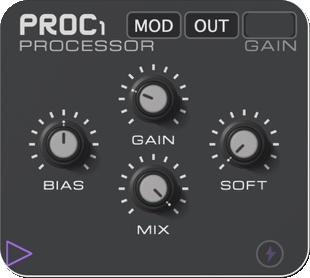
PROC modifies a modulation/control signal before it reaches its destination. It is the module for situations where the source is basically right, but needs manners.
Quick start
Put PROC between a modulation source and its target:
source → PROC → target
A practical example is smoothing ARP accent.
Engines
PROC currently provides twelve processing engines:
| Engine | What it is useful for |
|---|---|
| GAIN | Scale a signal, add bipolar bias and optionally soften it with saturation. |
| SHAPE | Bend the response curve and morph toward a sine-shaped response. |
| CLIP | Restrict a signal between independently chosen low and high boundaries. |
| DEADZONE | Ignore a region around a movable centre. Useful for making small movements do nothing. |
| FOLD | Wavefold a control signal for more complex movement. Subtle is optional. |
| QUANT | Reduce a continuous signal to 2–64 discrete levels. |
| COMPARE | Turn a continuous signal into threshold-based states, with hysteresis to prevent nervous switching. |
| SLEW | Smooth changes with independent rise and fall behaviour. Excellent for taming abrupt modulation. |
| S&H | Sample and hold a value when the trigger condition is met. |
| RECTIFY | Half/full-wave style processing for reshaping bipolar movement. |
| WRAP | Wrap values around the range instead of simply clipping them. |
| LIMIT | Dynamic limiting using threshold, ratio and makeup gain. |
Every engine also provides MIX, so you can blend the processed result with the original signal.
Why would I want this?
Suppose ARP ACC makes a filter jump too sharply. You could decide that brutal filter jumps are your new artistic direction. Or use SLEW and make the movement smoother.
PROC is also useful between LFOs and targets, before quantization, for turning smooth modulation into stepped patterns, and for generally abusing control signals until something interesting happens.
See also
Modulation · ARP · QNT · S&H