
Modulation
Modulation is what turns a static patch into a moving instrument. Instead of setting every knob once by hand, a modulation source continuously changes a target parameter for you.
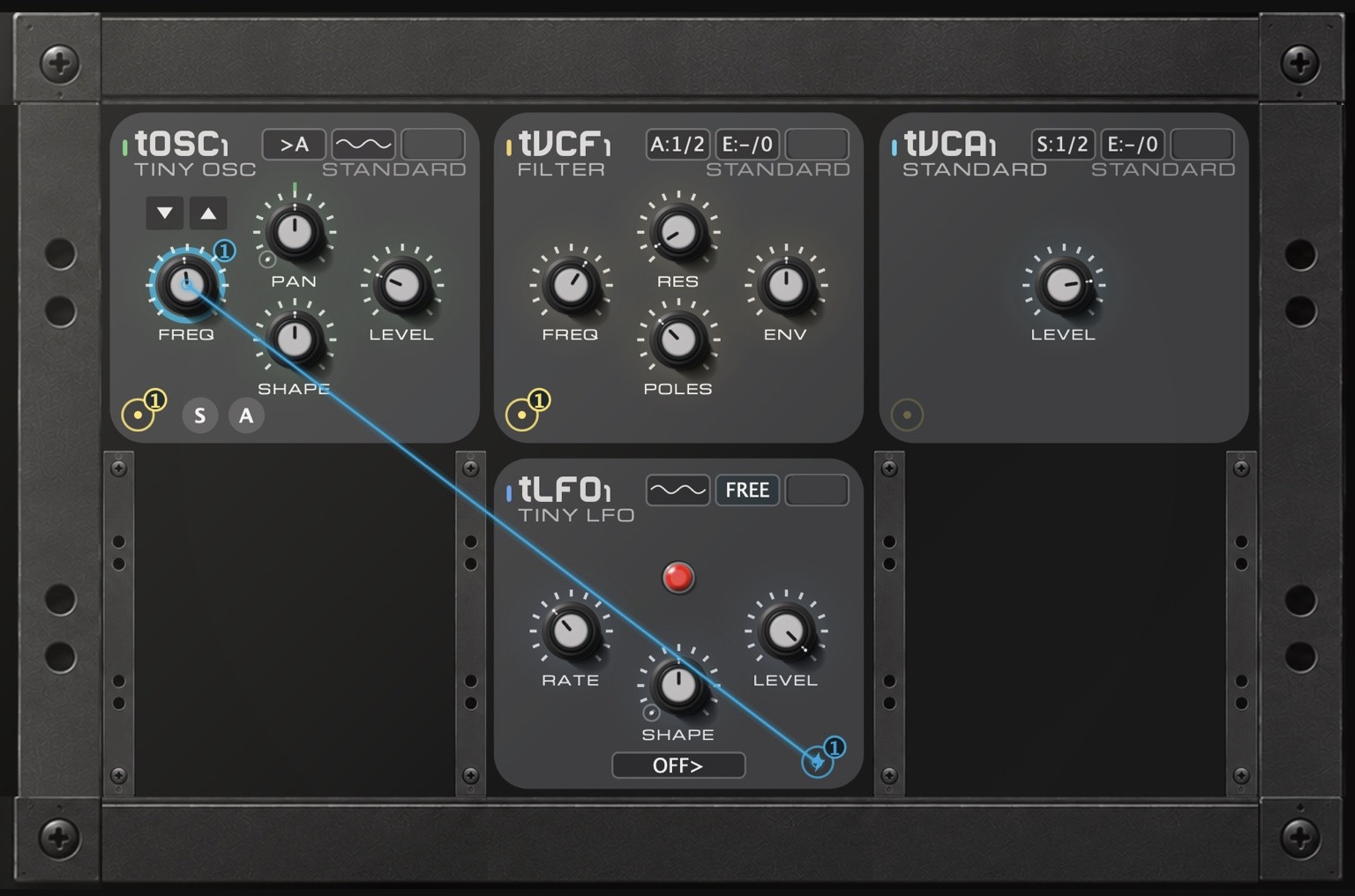
Source → target
A modulation connection always has two sides. The source produces a changing value — for example an LFO, envelope, performance signal or processor. The target is the parameter being changed, such as FREQ, LEVEL, PAN or SHAPE.
The knob remains the base setting
The target knob is still your manual setting. Modulation is applied around or from that setting according to the target and receiver behaviour. The route amount determines how much influence the source is allowed to have. This is important: changing the modulation amount is not the same as turning the target knob.
More than one modulation route
A target can participate in a more complex modulation setup, and a source can control multiple destinations. This is where RFM Space quickly becomes more expressive than a fixed synthesizer architecture: one movement can affect several parts of the sound, or several sources can contribute to one parameter.
Choose a slow example first
For a first experiment, connect a slow tLFO to oscillator or filter FREQ. A slow rate makes the relationship obvious: you can hear the parameter moving, change the amount, then move the base knob and immediately understand the difference between manual value and modulation.
Next: Gates & Triggers.