
Beyond Modular. Without the cable spaghetti.
Everything you need to build, route, modulate, sequence and occasionally create something you definitely did not plan. Written for musicians, not compiler enthusiasts.
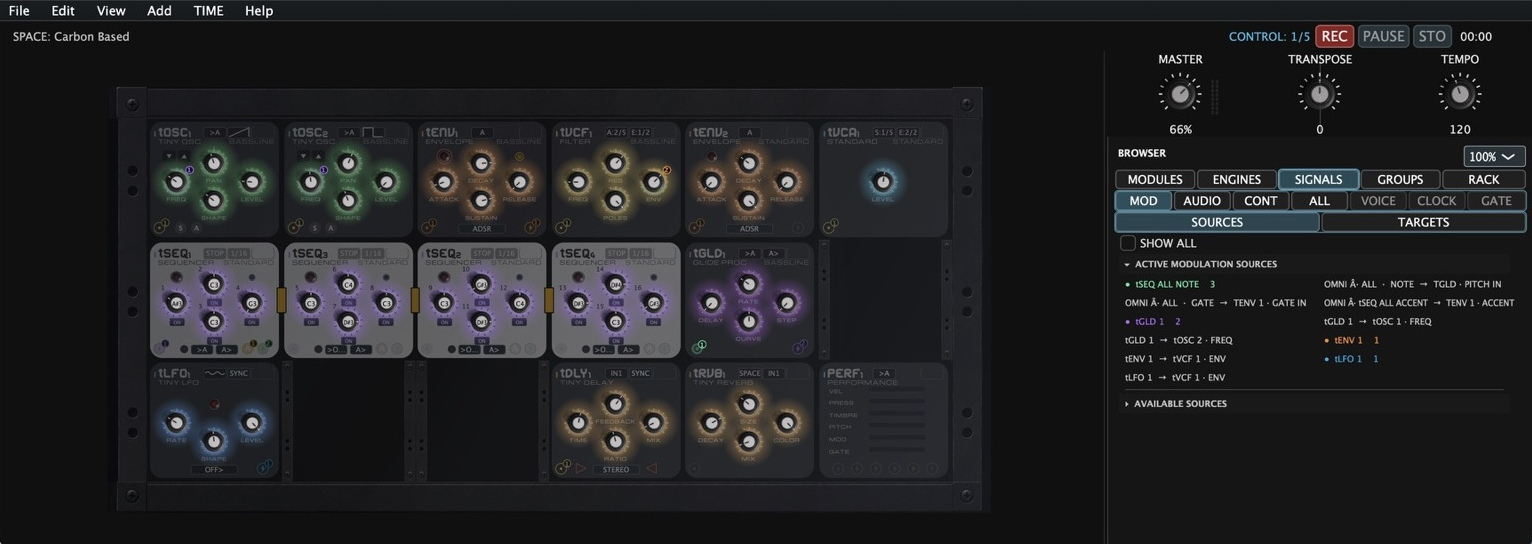

Getting Started
New to RFM Space? Build your first Space, connect things and get sound out before touching anything suspicious.
Core Concepts
Audio, modulation, gates, buses, groups, MIDI and MPE — the ideas that make the rest of RFM Space make sense.
Modules
The practical module reference: what each module does, how to connect it, controls, examples and useful tricks.
Tutorials
Build actual patches step by step. Start simple, then gradually make perfectly reasonable decisions less reasonable.
How Do I...?
Know what you want, but not where we hid it? Short answers for common jobs such as modulation, patching and merging.
Reference
Glossary, shortcuts and the things you only need once every six months — usually five minutes after forgetting them.
One module. More than one personality.
RFM Space is built around compact modules, central routing and swappable Engines. Change the Engine and the module can become a different oscillator, filter, envelope or sequencer without moving it, rewiring the patch or rebuilding the instrument around it.
That is what makes Space rather different from a rack full of fixed-function modules: the structure can stay put while the character changes underneath it. Less rebuilding. More listening.
Start making noise
First visit? Start with Your First Space and then Connecting Things. If modular synthesis is already home territory, jump straight into Modules.
What this manual is not
This is not the developer reference and it will not explain a C++ class unless that class suddenly starts making music. The manual is about using RFM Space: what things do, why they are useful and how to combine them.